In Eliot, Maine, the 2025 Comprehensive Plan revision highlights a severe housing affordability crisis. The median home price in 2023 was $599,500, unaffordable for 92.1% of Eliot households. Shockingly, every home sold that year went for even more, signaling a dire situation.
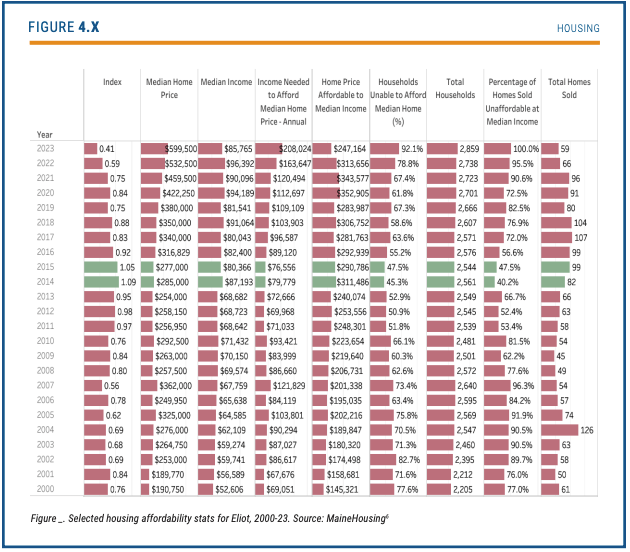
Since 2020, home prices have surged by $177,250—a 42% jump in just three years. Back then, four out of ten households could afford a median-priced home; now, fewer than one in ten can. This escalation happened despite rising interest rates, which climbed from around 3% to nearly 7%. Normally, higher rates cool demand and lower prices, but Eliot’s housing market defies this trend. Why? The COVID-19 pandemic may have shifted migration patterns initially bringing more permanent residents to Eliot, but with its proximity to the Naval Shipyard, easy access to I-95, and the sheer explosive growth in nearby towns like Portsmouth, Dover, and Rochester, Eliot, nestled in the heart of these Seacoast locations, is now a very hot spot.
Higher interest rates also discourage builders and developers from starting new projects. With expensive land and better investment options elsewhere, the supply of new homes in Eliot is shrinking, even as demand grows. This issue is compounded by the town’s zoning restrictions.
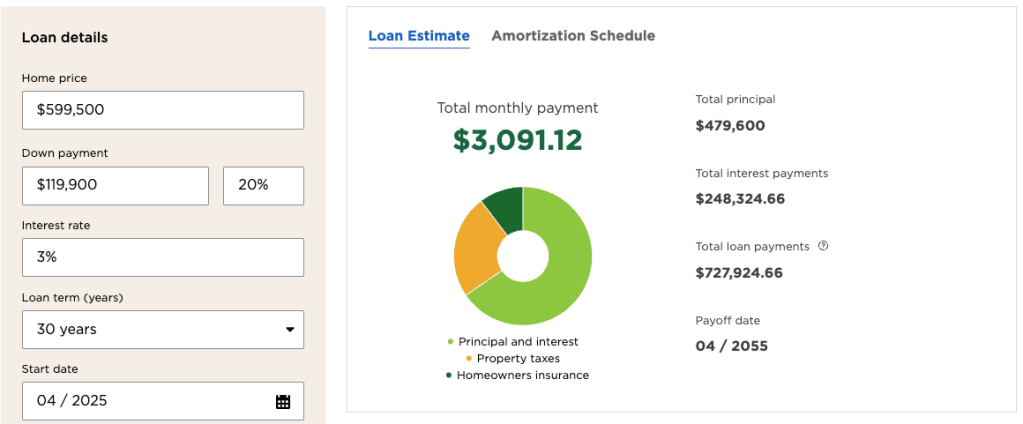
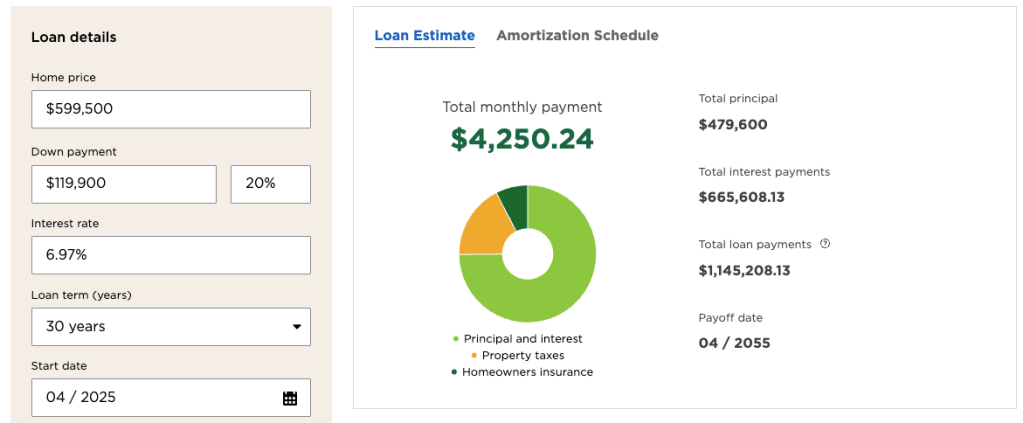
For homebuyers, the numbers are daunting. At the median price a $599,500 home with a 30-year mortgage and 20% down now costs $4,250 monthly at 6.97% interest, up from $3,091 at 3%. Over the loan’s life, you’d pay an extra $417,283 in interest and need an additional $1,159 each month compared to a few years ago.
With people still flocking to the area and the Comprehensive Plan’s proposed measures falling short, home prices are likely to keep climbing, making affordability even more elusive.
Enter Maine’s LD2003, a state law designed to boost housing supply, particularly through accessory dwelling units (ADUs). But Eliot’s local elected municipality has undermined this solution.
Link: LD2003 Guidance
LD2003:
- Purpose:
- Increases housing opportunities to alleviate Maine’s housing affordability crisis by reforming zoning and land use restrictions.
- Increases housing opportunities to alleviate Maine’s housing affordability crisis by reforming zoning and land use restrictions.
- Key Provisions:
- Multi-Unit Housing: Requires municipalities to allow up to four residential units (or structures) on lots zoned for housing, provided density and zoning standards (e.g., setbacks) are met.
- Accessory Dwelling Units (ADUs): Mandates allowing at least one ADU on any lot with a single-family home, including non-conforming lots if dimensional requirements are met; pre-LD 2003 “illegal” ADUs must be legalized. ADUs do not count in density limitations.
- Affordable Housing Density Bonus: Requires municipalities to allow higher density for affordable housing developments, as defined by the law.
- Fair Housing Amendments: Amends the Maine Human Rights Act to prohibit municipalities from using criteria like “character of a location,” “overcrowding of land,” or “concentration of population” to restrict housing development.
- No Caps on Permits: Prohibits municipalities from imposing caps on residential building permits.
- Priority Development Zones: Requires municipalities to designate zones for multifamily housing to streamline development.
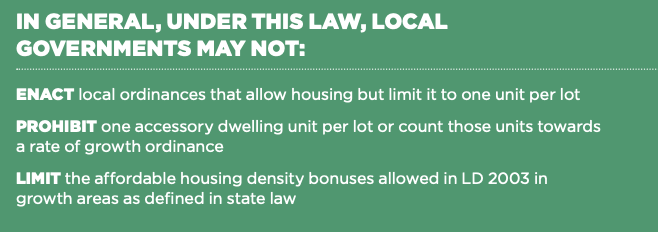
Under LD 2003, homeowners can build up to two ADUs—one attached to their home and one freestanding—without affecting zoning limits, creating up to three livable units per property. This could significantly increase housing options. However, Eliot added an “owner-occupied” clause, requiring the property owner to live on-site, effectively stalling this provision.
“Sec. 45-459. – Accessory dwelling unit.
(a) An accessory dwelling unit (ADU) may be rented so that the owner-occupant may benefit from the additional income. The owner may also elect to occupy the accessory dwelling unit and rent the principal dwelling unit.
(b) Owner–occupied means that either the principal dwelling unit or the ADU is occupied by a person who has a legal or equitable ownership interest in the property and bears all or part of the economic risk of decline in value of the property and who receives all or part of the remuneration, if any, derived from the lease or rental of the dwelling unit.”
Eliot Municipal Code: https://library.municode.com/me/eliot/codes/code_of_ordinances
Here’s why this matters: Most homeowners lack the money, time, or desire to build and manage one or two ADUs in their backyard. They don’t want the hassle of financing construction, finding tenants, or handling long-term property management. Homeowners value stable costs, predictable taxes, and enjoying their community with family and friends, not running a rental business.
Developers and investors, on the other hand, are well-suited for this. They have construction expertise, access to financing, and established networks to source materials and streamline building. Their ADUs are often more energy-efficient, compliant with regulations, and built faster, producing more high-quality housing. For them, ADUs align with their business models, focusing on market demand and long-term returns. They’re equipped to manage properties, handle maintenance, and navigate challenges that homeowners might find overwhelming.
By requiring owner occupancy, Eliot’s amendment discourages developers from building ADUs, limiting the law’s impact and going against the entire creation of the law in the first place. This restriction stifles the potential for more housing, leaving the town’s affordability crisis unresolved and residents struggling to find homes they can afford.

Considering the image above from the plan showcases the purported #1 goal, it seems a bit hypocritical considering the actions taken to get this point with specific regard the continued existence of the owner-occupied clause.
Note, the entire 2025 Comprehensive Plan does not address this owner occupancy requirement once and was intentionally written in a way to omit its continued existence.
If they truly cared about the housing affordability crisis, this would be the first thing they fixed.
Time to hold them to account.
 Eliot Maine